
A middle-aged Nigerian woman has revealed how she supposedly abandoned her successful Lagos fashion venture after her husband convinced her to move to their newly built house in Ibadan, only for him to stay behind in Lagos for months.
The individual, known on Facebook as Kosoko Zainab Adepeju, described her ordeal in a widely shared online post.
Initial Hesitation About the Move – Woman’s Account
She explained that both she and her spouse were financially stable while living in Lagos.
She noted that she ran a thriving tailoring enterprise employing roughly a dozen apprentices, generating sufficient income for her livelihood.
Nevertheless, after her spouse finished constructing their home in Ibadan, he urged the whole family to move there.
She admitted that she resisted the idea of moving to Ibadan, fearing she would have to leave behind the business she had nurtured for years, but ultimately conceded after pressure from both families to join her husband.
Spouse Allegedly Remained in Lagos
She stated that she shut down her fashion shop, moved with their children, and anticipated her husband would follow once he transferred his remaining possessions.
However, she later said he told her he had obtained a lucrative, multi‑million‑naira position in Lagos and therefore needed to stay behind.
She recounted that after agreeing to relocate, she placed her apprentices with trusted designers, distributing some to six fashion houses and giving four the opportunity to work independently. She packed belongings with her children while her husband said he would handle his own items.
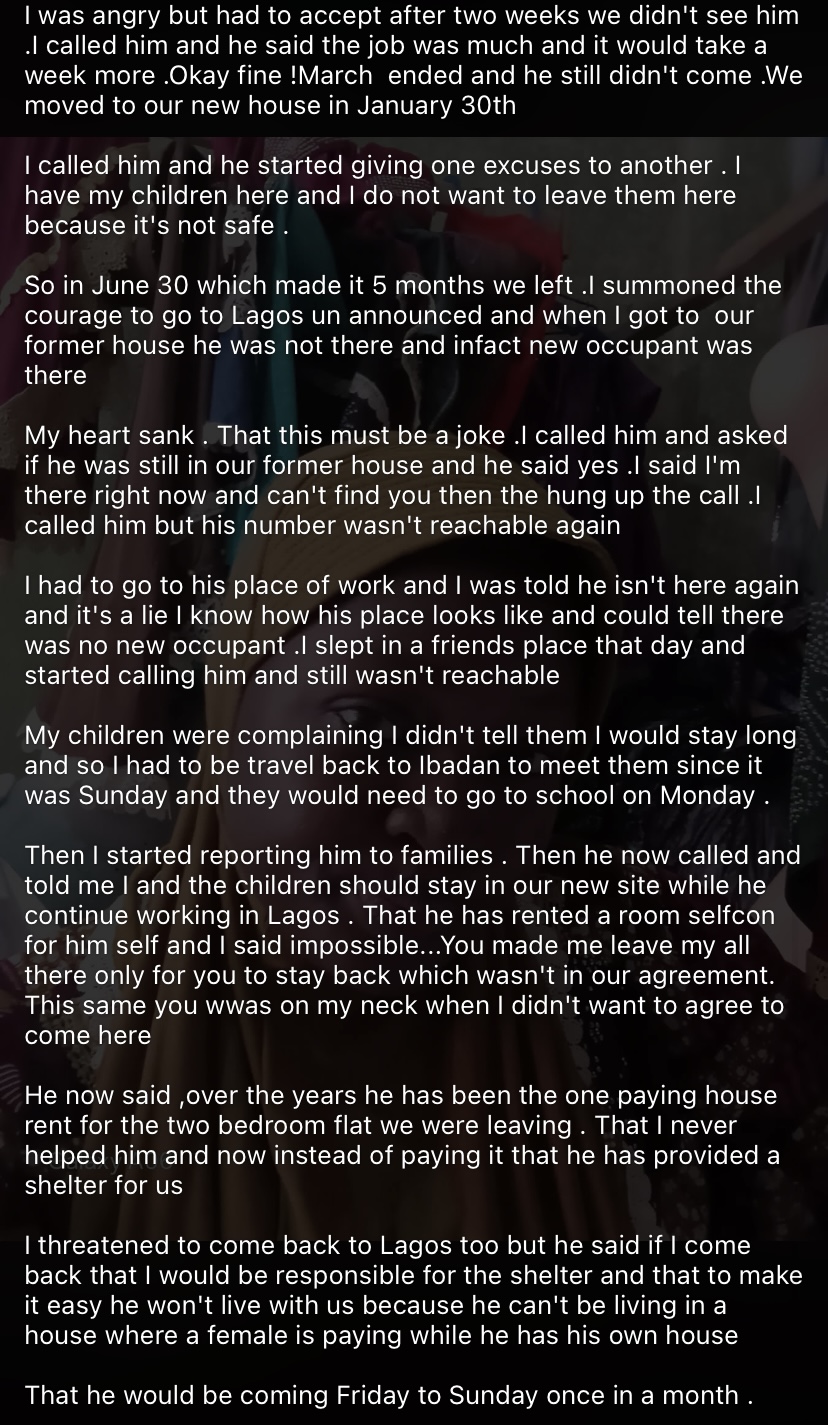
When the moving truck arrived, she loaded her tailoring machines and other goods first; her husband instructed the driver not to load his possessions, claiming a bus would come for them. They traveled together in their car, and the next day he returned to Lagos, saying the bus for his belongings was en route. That evening he announced a sudden, lucrative job opportunity requiring immediate attention before he could redirect clients to Ibadan. She felt angry but complied. After two weeks without seeing him, she called; he said the job would take another week. March ended and he still had not arrived. They had moved into the new house on January 30. She continued calling, receiving various excuses.
By June 30, five months later, she decided to visit Lagos unannounced. Upon arriving at their former residence, she discovered a new occupant and her husband was absent. She called him; he claimed he was still there, but when she said she was present and could not locate him, he hung up. Subsequent calls went unanswered. She went to his workplace, where she was told he was no longer employed there and that the place showed no signs of a new tenant. She spent the night at a friend’s house, attempting repeatedly to reach him without success. Her children complained that she had not informed them she would be away for an extended period, prompting her to return to Ibadan on Sunday so they could attend school Monday. She then reported the situation to both families. Later, her husband contacted her, insisting that she and the children remain in the Ibadan home while he continued working in Lagos, mentioning he had rented a self‑contained room for himself. She rejected this, arguing that he had uprooted her from everything she built only to stay behind, contrary to their agreement. He responded by noting that over the years he had paid the rent for their Lagos flat, that she had never contributed, and now he had provided shelter for the family. She threatened to return to Lagos, but he replied that if she did, she would be responsible for the shelter and that he would not live with her because he could not reside in a house where a woman pays while he owns his own property. He said he would visit only Friday through Sunday once a month. She lamented that in Ibadan there were few customers, and those who did come expected her to sew garments for as little as ₦1,000–₦2,000, and even a ₦3,000 request would be refused. She questioned whether she should spend her life under such conditions, expressed her anguish, and appealed to other women for advice, asking what a 45‑year‑old should do.
She shared the following screenshots to illustrate her situation.


About the Author